Warcryer

Warcryer vs TeamSpeak

TeamSpeak has carried large alliances for twenty years, with channels, whisper lists and a deep permission system that each community wires up for itself. Warcryer starts from the other end: the event's roster decides who hears whom, and the wiring is done for you.

Checked against TeamSpeak's own pages on . Warcryer is in beta.

The short answer

Choose TeamSpeak if

  • You want your own server, on your own hardware, under your own rules.
  • Your players are on macOS, Linux or phones.
  • You need one place for the whole week: open channels to sit in, screen sharing, files.
  • You already have a channel tree and whisper setup that your players know, and it works.

Choose Warcryer if

  • Your events have a chain of command: an event leader, clan leaders, party leaders, parties.
  • You are tired of telling new players how to set up whisper keys before every siege.
  • You move players between parties during a fight and need their voice to follow.
  • You keep sign-ups, party lists and attendance in a spreadsheet beside the voice app.

Side by side

WhatWarcryerTeamSpeak
Who decides who hears whomThe event's roster. Players are placed on their nets when the operation starts and never pick a channel.Each player joins a channel. Admins build the channel tree and its permissions.
Hearing several groups at onceBuilt in: every player is on up to five nets at once (Broadcast, Command, Clan, Party, Reserve), each with its own key.Whisper lists in TeamSpeak 3, set up by each player on their own client.
A leader's voice over the restAutomatic: while someone speaks on a higher net, the nets below it are lowered for everyone who hears both.Priority speaker and Channel Commander in TeamSpeak 3, granted through permissions.
Moving a player mid-fightDrag them to another party on the roster board. Their voice follows in a second or two, with a sound to tell them.An admin drags the player to another channel.
Sign-ups, parties and what each party lacksBuilt in: who is coming, constant parties, a drag-and-drop board that shows which roles a party still needs.Not part of TeamSpeak. Alliances use a spreadsheet, a website or a Discord bot.
AttendanceRecorded and kept with each operation: who was in voice, and for how long.Not part of TeamSpeak. Usually a screenshot of the channel tree.
Event text chatA channel per net, a pinned order, a ready check, and quick calls on a key, in a window that sits on the game.Global and direct text chat. No order line, ready check or calls tied to an event.
HostingHosted for you. You cannot run your own server.Run your own server, rent one, or use TeamSpeak's own hosted Communities.
PriceFree while in beta.The client is free. Servers are licensed or rented by the slot.
Source codeThe Windows app is open source (MIT). The server is not public.Proprietary.
Runs onWindows 10 and 11. A browser version for a quick look.Windows, macOS, Linux, Android and iOS.
Size300 approved members per alliance during the beta.As many slots as your licence or plan has.
Beyond voiceNothing beyond the event: no video, screen sharing or file sharing.Screen sharing, file sharing, and a server that is there all week, not only for events.

TeamSpeak 6 is in beta at the time of writing, beside TeamSpeak 3. Whisper lists, priority speaker and Channel Commander are described here as they work in TeamSpeak 3. TeamSpeak's site does not list prices for server licences at the moment; see its licensing page.

What is different in practice

Nobody sets up whispers

In TeamSpeak a party leader who must reach Command, their clan and their party sets up a whisper list and a key for each, on their own client, and has to change it when the roster changes. In Warcryer the leader is on Command because the roster says they lead a party. Hand the party to someone else and the new leader is on Command at once, with nothing to configure.

One roster instead of a channel tree

A TeamSpeak siege usually means a channel per party and admins dragging names between them. Warcryer's board is the party list itself: drag a player from one party to another and their audio moves with them, they hear a sound, and their screen says where they went.

The call is heard

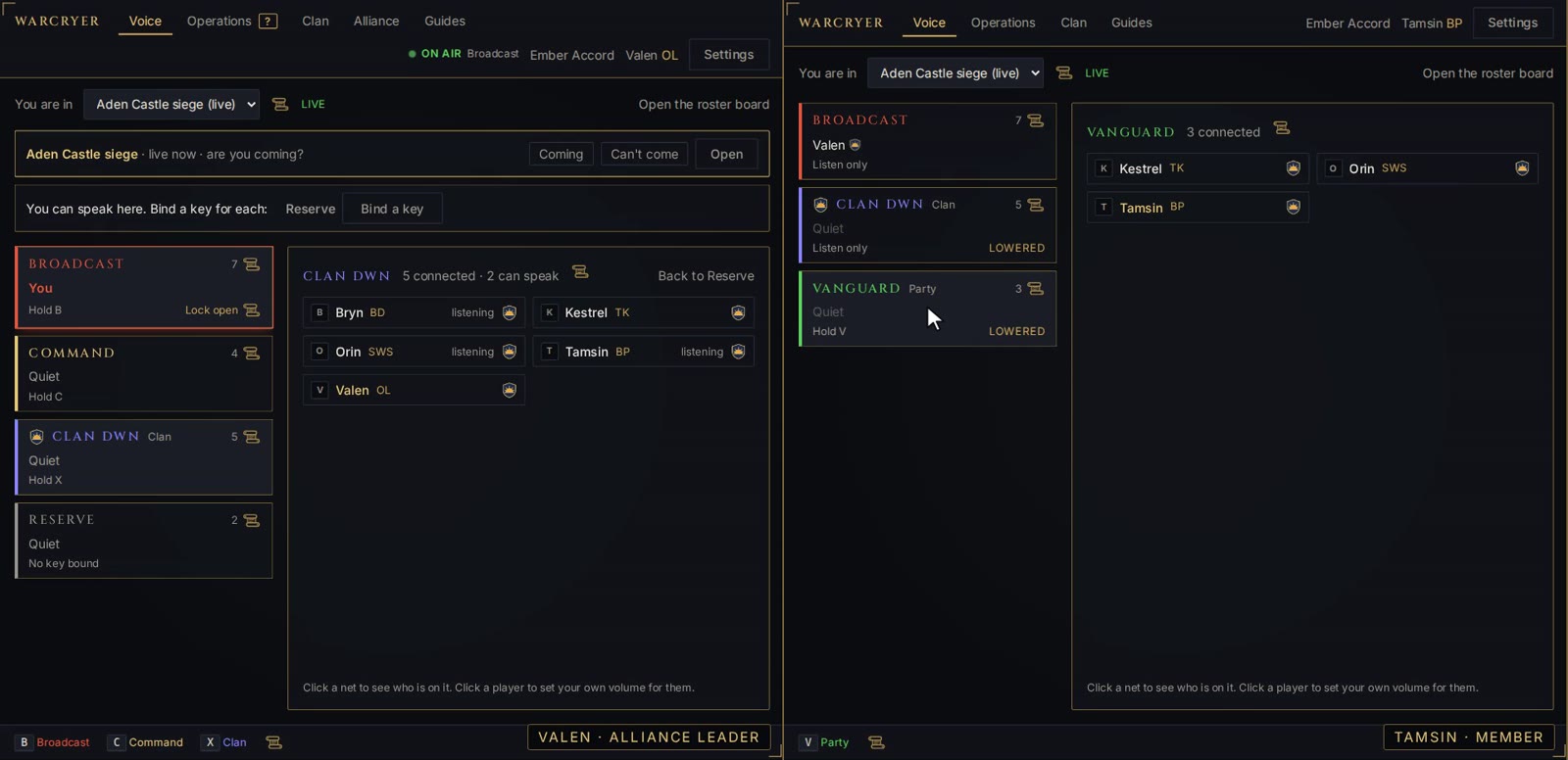
TeamSpeak can give a leader priority, but someone has to grant it and players can still be talking in a channel the leader is not in. In Warcryer a Broadcast order lowers every party's chatter for as long as the leader speaks, for everyone, without anyone setting it up.

The event around the voice

Who is coming, which party lacks a healer, who actually turned up and for how long: TeamSpeak leaves all of that to other tools. In Warcryer it is the same window, and attendance is counted from who was really in voice.

Left, the event leader holds the Broadcast key. Right, a member's Clan and Party nets are lowered while the order is given.
While a leader speaks on Broadcast, the nets below it are lowered for everyone.

Where TeamSpeak is the better choice

Warcryer does one thing, and it is young. These are its limits today.

Coming over from TeamSpeak

  1. Keep your TeamSpeak server for the rest of the week if you like it. Warcryer is for the events.
  2. Start your alliance in the app and choose the starting lists for your game: classes, party size, roles.
  3. Create your clans and send each clan leader an invite link. Their members come in through it.
  4. Plan the first operation, build its parties on the board, and go live. Players bind one key per net they may speak on.

Questions

Is Warcryer a free alternative to TeamSpeak?
It is free while it is in beta. An alliance is started with a code from the Warcryer Discord, and the players who join it need none.
Can I host Warcryer on my own server, as I can with TeamSpeak?
No. Warcryer is a hosted service. The Windows app is open source, but the server is not public. If running your own server matters to you, TeamSpeak or Mumble is the better choice.
Does Warcryer have whisper lists or Channel Commander?
It does not need them. Every player is on several nets at once, each with its own push-to-talk key, and which nets those are comes from their place on the roster. A higher net lowers the ones below it by itself.
Which games does it work with?
Any game played in windowed or borderless mode. Nothing is injected into the game or read from it. There are starting lists for Lineage 2, World of Warcraft and Throne and Liberty, and an alliance can write its own.

Sources

Everything said about TeamSpeak here comes from its own pages, read on 18 November 2026.

Also compared: Warcryer vs Discord · Warcryer vs Mumble · Warcryer vs Ventrilo

Try it on your next event

Warcryer is in beta and nothing is charged for it. Download the Windows app, ask for a beta code on the Warcryer Discord, and start your alliance.