Warcryer

Warcryer vs Mumble

Mumble is free, open source and very good at what it does: low-latency voice on a server you run yourself, with a permission system that can express almost anything. Warcryer gives up that freedom for one thing done for you: the event's roster decides who hears whom.

Checked against Mumble's own pages on . Warcryer is in beta.

The short answer

Choose Mumble if

  • You want to run the server yourself and keep every byte under your own control.
  • Open source on both ends matters to you.
  • Your players are on Linux or macOS.
  • You want positional audio, or an overlay drawn in the game.
  • You have someone who enjoys writing ACLs and will keep them right.

Choose Warcryer if

  • Nobody in your alliance wants to run a server or maintain a permission tree.
  • Your events have a chain of command that changes every week with the roster.
  • You want sign-ups, party building and attendance in the same place as the voice.
  • New players should be talking in the right place within a minute of joining, without a setup guide.

Side by side

WhatWarcryerMumble
Who decides who hears whomThe event's roster. Players are placed on their nets when the operation starts and never pick a channel.Each player joins a channel. Admins write ACLs and groups for the channel tree.
Hearing several groups at onceBuilt in: every player is on up to five nets at once (Broadcast, Command, Clan, Party, Reserve), each with its own key.Linked channels share their talk, and players can set up whisper and shout keys on their own client.
A leader's voice over the restAutomatic: while someone speaks on a higher net, the nets below it are lowered for everyone who hears both.Priority speaker, set by an admin for a user in a channel.
Moving a player mid-fightDrag them to another party on the roster board. Their voice follows in a second or two, with a sound to tell them.An admin drags the player to another channel.
Sign-ups, parties and what each party lacksBuilt in: who is coming, constant parties, a drag-and-drop board that shows which roles a party still needs.Not part of Mumble. Alliances use a spreadsheet, a website or a bot.
AttendanceRecorded and kept with each operation: who was in voice, and for how long.Not part of Mumble.
Event text chatA channel per net, a pinned order, a ready check, and quick calls on a key, in a window that sits on the game.Text messages to channels and users. No order line, ready check or calls tied to an event.
HostingHosted for you. You cannot run your own server.Run your own server, or rent one from a third party.
PriceFree while in beta.Free.
Source codeThe Windows app is open source (MIT). The server is not public.Open source, client and server.
Runs onWindows 10 and 11. A browser version for a quick look.Windows, macOS and Linux. Phone apps are third-party.
Size300 approved members per alliance during the beta.Whatever your own server can carry.
Beyond voiceNothing beyond the event: no video, screen sharing or file sharing.Positional audio in games that support it, an in-game overlay, and a multi-channel recorder.

Mumble 1.5.939 was the latest stable version at the time of writing. Mumble's own iOS app is no longer maintained; its site lists third-party phone apps.

What is different in practice

A roster instead of ACLs

Mumble's access control lists and groups can describe a fleet's command structure, and large communities have done it. Somebody has to write it and keep it matching the people. In Warcryer the structure is the roster: make someone a deputy or a party leader and their voice rights change with the role, in that moment.

No shout keys to hand out

In Mumble a leader reaches other channels with whisper and shout shortcuts that each player sets up on their own client. In Warcryer everyone has one key per net they may speak on, and which nets those are is decided for them.

Nothing to host

A Mumble server is yours: to install, secure, update and pay for. Warcryer is hosted, which is less freedom and less work. If self-hosting is the point for you, Mumble wins this one outright.

The event around the voice

Mumble is a voice application and does not try to be anything else. Warcryer also asks who is coming, shows which party lacks a healer, moves players between parties with their audio, and records who attended.

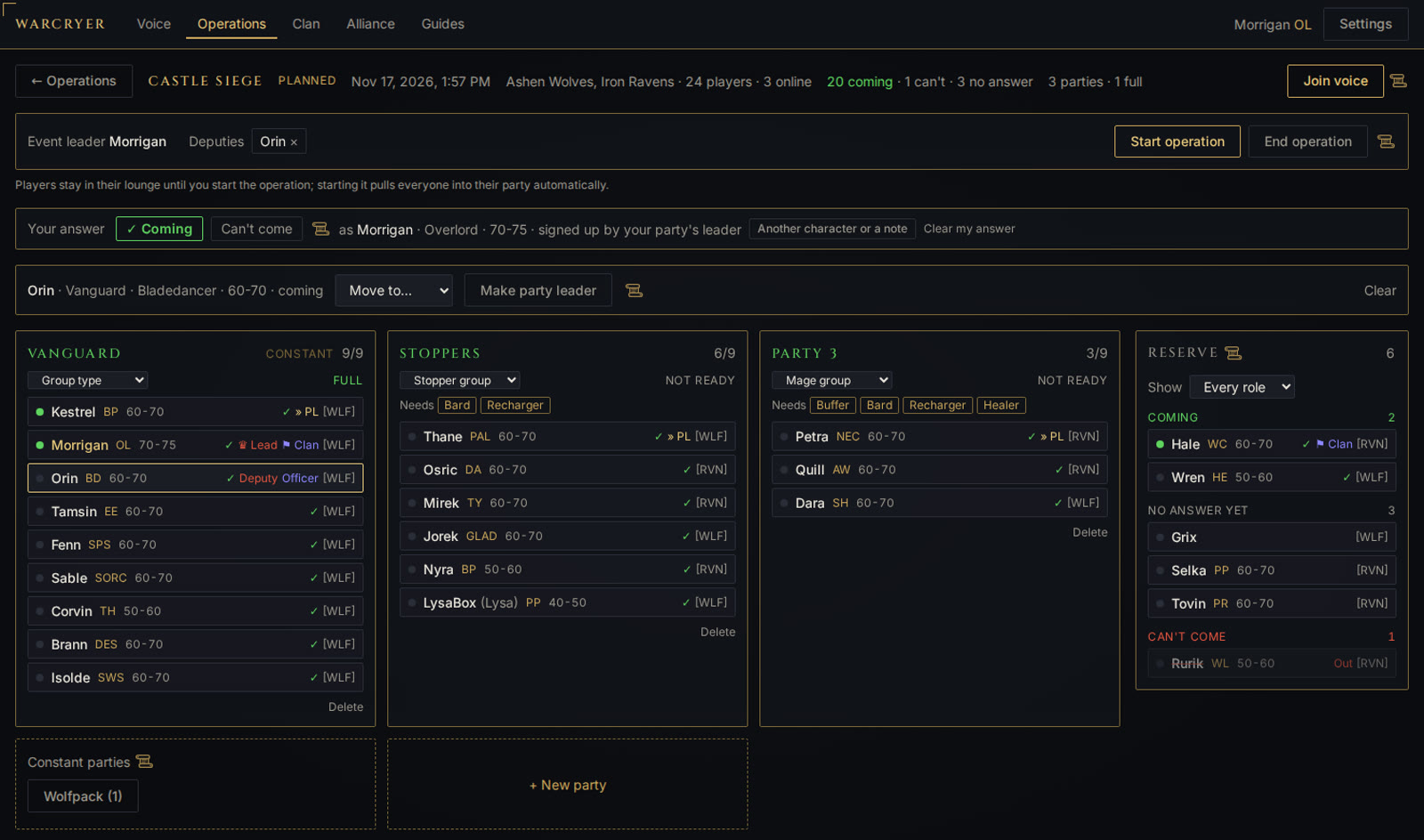
A planned operation on the roster board: one party is full, the other two list the roles they still need.
A planned operation. One party is full; the other two list what they still need.

Where Mumble is the better choice

Warcryer does one thing, and it is young. These are its limits today.

Coming over from Mumble

  1. Keep your Mumble server for everyday talk if you like it. Warcryer is for the events.
  2. Start your alliance in the app and choose the starting lists for your game, or write your own.
  3. Create your clans and send each clan leader an invite link. No certificates or registrations to hand out.
  4. Plan the first operation, build its parties on the board, and go live.

Questions

Is Warcryer open source like Mumble?
Partly. The Windows app is open source under the MIT licence and every release is built from the public repository. The server is not public. Mumble is open on both ends.
Can I self-host Warcryer?
No. It is a hosted service. If you want your own server, Mumble is the better choice.
Does Warcryer have positional audio?
No. Nothing is read from the game, so the app does not know where anyone stands. Voice is organised by the chain of command instead: party, clan, command, broadcast.
Is the latency as low as Mumble's?
We have not measured the two side by side and will not claim it. Warcryer's voice runs over WebRTC with the Opus codec, as most current voice services do.

Sources

Everything said about Mumble here comes from its own pages, read on 18 November 2026.

Also compared: Warcryer vs TeamSpeak · Warcryer vs Discord · Warcryer vs Ventrilo

Try it on your next event

Warcryer is in beta and nothing is charged for it. Download the Windows app, ask for a beta code on the Warcryer Discord, and start your alliance.